
Does your door catch on the frame, drag along the carpet or leave a draught down one side? In most cases you can adjust door hinges yourself in under twenty minutes, and you only need a hex key or a screwdriver. A door that has dropped even three or four millimetres will rub, stick and refuse to lock properly. The hinges control exactly that, and they give you far more adjustment than most homeowners realise.
Below we explain how to read the problem, which screw to turn, and when the hinges are not actually the fault at all.
First, work out which way your door has moved
Close the door and look at the gap around it. That gap tells you everything.
- Tight along the top of the latch side, wide at the bottom: the door has dropped on its hinges. Lift it.
- Rubbing at the bottom of the latch side: the door has sagged forward. Lift it, or pull it back towards the hinges.
- An even but wide gap all round: the door sits too far out from the frame. Compress it inwards.
- Draught down the hinge side only: the door does not pull tight against the seal. Adjust the compression.
- The door locks when you hold it open, but not when shut: the multipoint bolts miss the keeps. Adjust the height first, then the compression.
Mark the rub spot with a pencil before you touch anything. That way you can see straight away whether your adjustment helped or made things worse.

How to adjust uPVC and composite door hinges
Modern uPVC and composite doors use adjustable flag hinges or butt hinges, and they move in three directions. Most take a 4mm or 5mm hex key.
1. Height adjustment, up and down
Find the small grub screw at the very top or bottom of the hinge barrel. Some hinges hide it under a plastic cap that you simply prise off. Turn the screw clockwise to raise the door and anticlockwise to drop it. Adjust every hinge by the same amount, or you will twist the door. Move a quarter turn at a time, then close the door and check.
2. Lateral adjustment, side to side
Look for the screw on the face of the hinge, usually behind a cap on the frame side. Turning it pulls the door towards the hinges or pushes it away from them. Use this one when the latch side rubs on the frame, or when the lock barely reaches its keep.
3. Compression adjustment, in and out
The compression screw sits on the side of the hinge and controls how tightly the door squeezes against the weather seal. Tighten it if you feel a draught. Slacken it if the door needs a shove to close. Set all hinges the same, otherwise the door seals at the top and gapes at the bottom.
Always adjust one axis at a time. If you change height and compression together, you will not know which one fixed it, or which one caused a new problem.
How to adjust timber door hinges
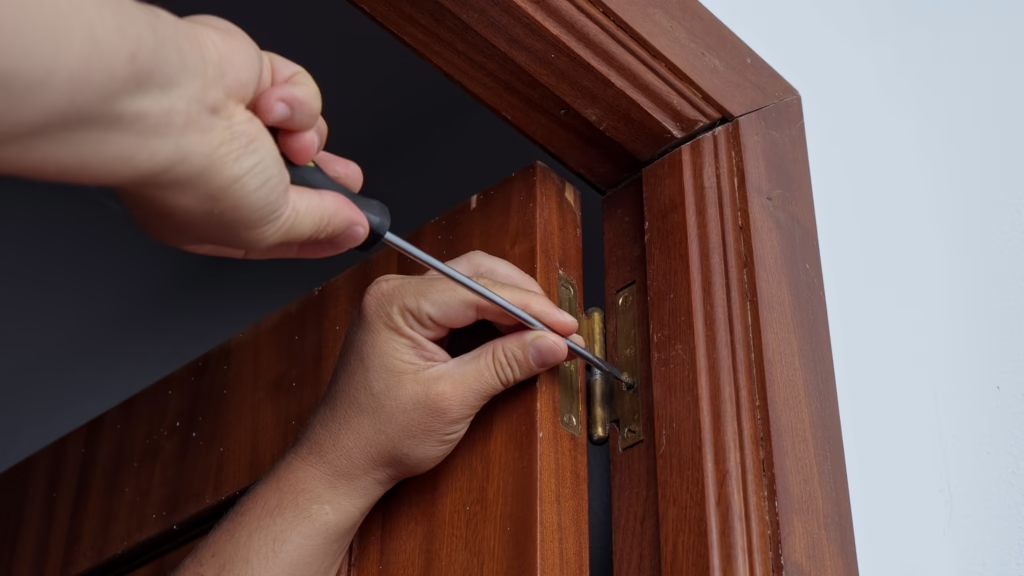
Timber doors use fixed butt hinges, so you adjust them differently.
Tighten the screws first. Open the door, take the weight on your knee, and drive every hinge screw home. Loose screws cause the majority of sagging timber doors.
Replace stripped screws. If a screw spins without biting, the hole has worn. Swap it for a longer screw, 63mm or more, so it reaches the frame timber behind the lining. That single change often lifts a door back into place.
Pack the hinge. If the door rubs on the latch side near the top, cut a piece of thin card to the shape of the bottom hinge leaf and slip it behind. Packing the bottom hinge tilts the door upwards at the latch edge. Pack the top hinge instead to move the door the other way.
Deepen the rebate. When a door binds against the hinge side, the hinge sits proud. Remove it, pare the recess a millimetre deeper with a sharp chisel, then refit.
What you need
- 4mm and 5mm hex keys
- A Pozidriv screwdriver
- A pencil
- Thin card or hinge packers
- A helper for heavy composite doors
Never adjust a hinge while the door hangs on it alone. Wedge the bottom of the door with a folded towel so it cannot drop and strain the remaining fixings.
When the hinges are not the problem
Adjustment solves a lot, but not everything. Call a professional if you notice any of these.
- The handle lifts but the bolts stay put. The gearbox inside the multipoint mechanism has failed, and no amount of hinge adjustment will help.
- The frame itself has moved. If the frame bows, or the brickwork above it has cracked, the door is a symptom rather than the cause.
- The door only sticks in hot weather. uPVC expands in heat and contracts in cold, so a seasonal fault usually needs a small compression change rather than a major one.
- The hinge is cracked or worn. Flag hinges eventually wear at the pin. Once they do, they will not hold an adjustment.
- The glass has slipped in the frame. On a glazed door, worn packers let the glass drop and pull the whole door out of square. Re-toeing the glass fixes it.
We repair all of these. Take a look at our door hanging service if a door needs rehanging altogether, or our uPVC door page if the door has reached the end of its life.
Why doors drop so often in Bournemouth and Poole
Life by the coast gives doors a hard time. Salt-laden air corrodes hinge pins and screw threads faster than it does inland, and the swing between damp winters and hot summers makes uPVC expand and contract more than most homeowners expect. Add a heavy composite door hung on three hinges and a decade of daily use, and a few millimetres of drop becomes almost inevitable.
That is why we recommend checking your hinges once a year. Tighten the screws, clean the moving parts, and apply a little dry PTFE spray to the pins. Ten minutes of maintenance prevents the dropped door that stops locking in January. The Door and Hardware Federation publishes further guidance on door hardware standards if you want to read around the subject.
Adjusted the hinges and still stuck? Call JCarter Locksmiths
If your door still rubs, sags or refuses to lock, our engineers will sort it properly. We cover Bournemouth, Poole, Christchurch and the surrounding areas:
- Hinge adjustment, repair and replacement on uPVC, composite and timber doors
- Dropped and misaligned doors realigned the same day
- Multipoint mechanisms, gearboxes and keeps repaired
- Free, upfront quotes with no call-out fee
- Family-run, military veteran-owned, hundreds of five-star reviews
Call or WhatsApp us on 07842 252 025. See our door hanging services or request a free quote.
Frequently asked questions
Which way do I turn the screw to lift a uPVC door?
Turn the height screw clockwise to raise the door and anticlockwise to lower it on most hinges. Move a quarter turn at a time on every hinge, then test the door before you go further.
Can I adjust a door hinge without taking the door off?
Yes. uPVC, composite and aluminium doors adjust in place with a hex key. Timber doors also allow you to tighten screws and pack hinges with the door hung, although a deeper rebate means taking the door down.
Why does my door only stick in summer?
Heat expands uPVC and swells timber, so the door presses harder against the frame. Slacken the compression slightly for the warmer months, or ask us to set a compromise position that works all year.
How long does a professional hinge adjustment take?
We normally realign a door in 20 to 40 minutes. If the hinges have worn out or the mechanism has failed, we carry common parts in the van and usually complete the repair in the same visit.


